Thresholds, Doors, Portals…
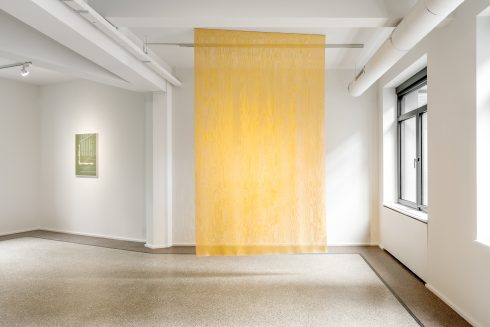
Inspired by Mark Fisher’s writings in The Weird and the Eerie in which presences and absences disturb by exposing the contingency of what we take as natural, the exhibition unveils a reality that is not fixed but open to forces from the outside.
Curated by Ariane Sutthavong.
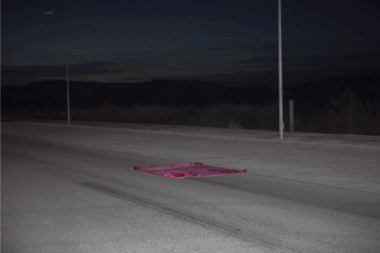
Image: Violeta Mayoral
Untitled XXV (Alguna Direccion series) 2024
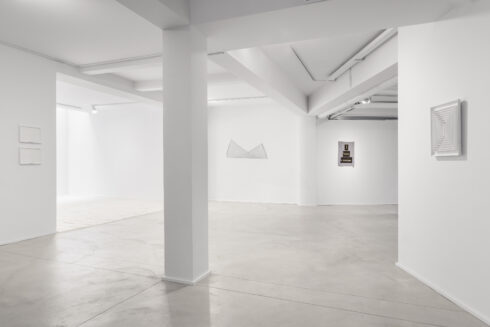
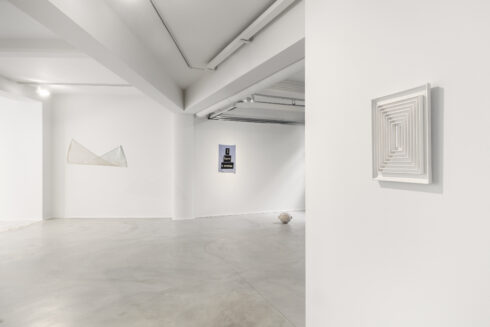
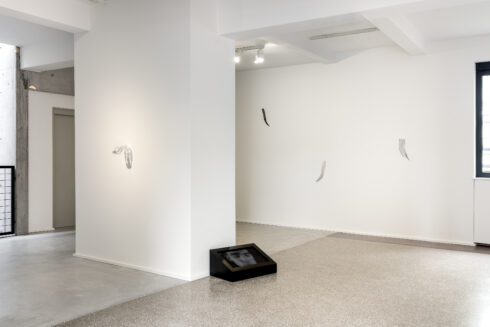
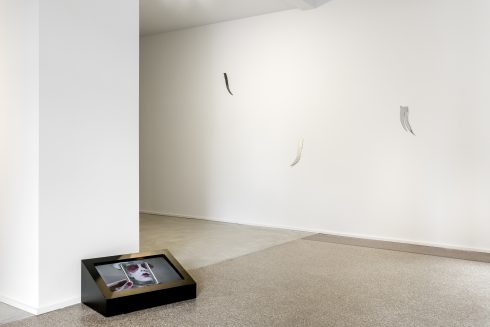
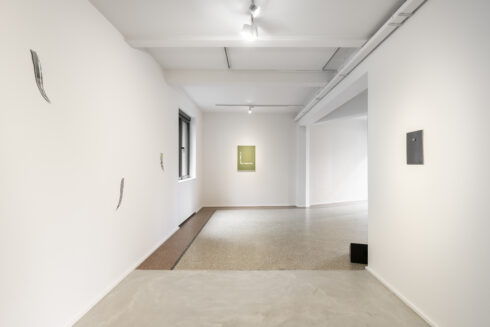
Exhibition views © Hugard & Vanoverschelde
Late capitalism thrives on the illusion of fluidity. We are sold a vision of seamless circulation, of facilitated consumption of images, ideas and identities while ever more barriers are being erected. What might emerge when the world we encounter is it no longer frictionless? When uncertainty and fragility are not obstacles but propositions, when demands for legibility are met with a refusal to be fully grasped and resistance to the compulsion to reduce, measure or contain?
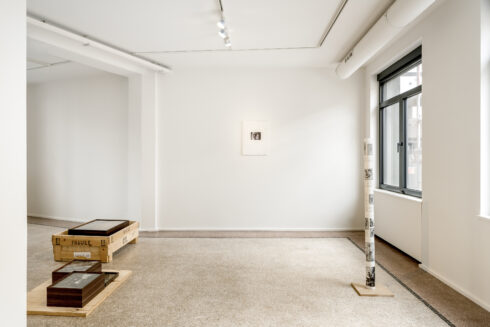
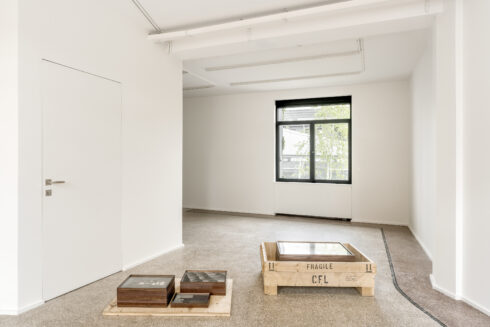
Embracing instability as a mode of enquiry, Thresholds, Doors, Portals... convenes works by 24 artists who probe the unsteady space of passage, transmission, translation and transformation, unsettling habitual ways of navigating geographies, meanings and relations.
Inspired by Mark Fisher’s writings in The Weird and the Eerie in which presences and absences disturb by exposing the contingency of what we take as natural, the exhibition unveils a reality that is not fixed but open to forces from the outside. Unlike a corridor, which prescribes a movement, a door does not merely suggest transition but signals a rupture, leading not to certainty but to unknowns.
Thresholds become sites of encounter between alternatives, holding within their precarity a potentiality, a proposition not yet fully formed. Portals gesture toward the imagination and activation of other modes of existence. The artists invite us to linger in these moments of tension and irresolution, where the known world begins to slip and something else altogether starts to emerge. We remain in a state of suspension.
24 artists
Marc Buchy, Sten Ceulemans, Valère de Meeûs, Nathalie Muchamad and Angyvir Padilla were invited to present artworks alongside pieces in Frédéric de Goldschmidt’s collection by Francis Alÿs, Claire Andrzejczak, Babi Badalov, Elena Bajo, Charles Baudelaire, Mel Bochner, James Scott Brooks, Ting-Jung Chen, Gaëlle Choisne, Lionel Dury, Stefano Faoro, Esther Ferrer, Nadia Guerroui, Mona Hatoum, Tarek Lakhrissi, Violeta Mayoral, Walid Raad, Jamie Reid & Martin Sexton, Trevor Yeung.
Ground Floor
Crafted with surgical precision, Lionel Dury’s Nuage Atomique evokes the turbulence of natural forces that defy borders and containment. His embroidered forms emerge not through addition but through removal, resisting legibility and subverting the map as an instrument of power. While echoing the colonial practice of carving up territories, this act also proposes a quiet reparation—an attempt to undo divisions.
Meanwhile, the buoy—a marker of borders and surveillance—is reimagined by TingJung Chen in Envelope (392 Hz), layered with fragments of political newspapers, speaking to the tenuous, shifting nature of geopolitical conflicts and the slow erosion of fixed truths. What once signalled control now wavers in meaning.
Esther Ferrer’s Monochrome from the series “Dans le cadre de l’art…” overturns the rigidity of frames and perspectives, while the elliptical nature of an airplane journey—marked by James Scott Brooks only by hollow traces of departure and destination in his Aether Airports—is confronted with works that highlight more precarious experiences of migration.
Rooted in his personal experience of displacement and the linguistic dissonance that comes with moving across borders, Babi Badalov’s visual poetry disas...
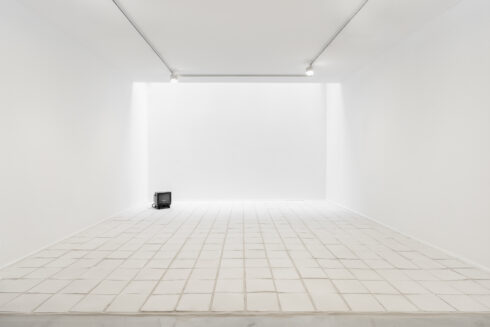
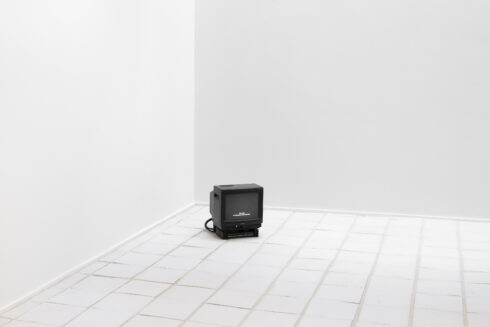
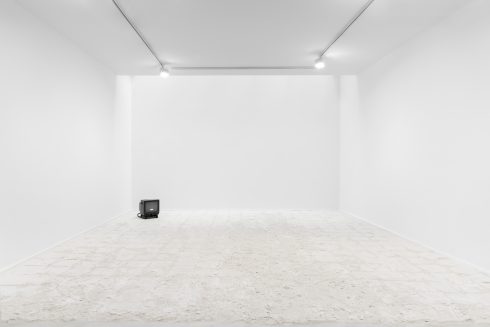
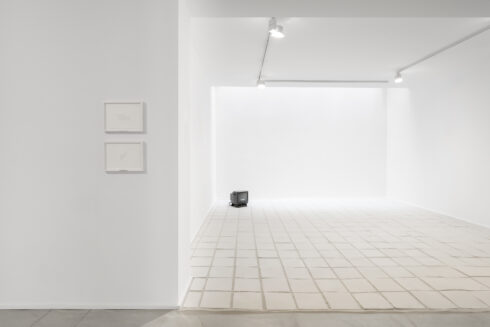
Angyvir Padilla’s immersive installation Domestic Ghosts reflects a space in flux—a house where architectural logic has become fractured under the weight of time and necessity. Here, you don’t move through rooms—you trespass, drift, hesitate. Born from a residency in one of Caracas’ colonial neighbourhoods, her conversation with a friend blind to this part of the city is a call and response between the seen and the unseen, the remembered and the speculative.
Presence and absence are further explored in perdre. Valère de Meeûs invites visitors into an unstable archive, unsettling the promise of permanence. Participants are asked to record a memory of the last time they were lost—but to do so, they must erase the previous memory. Their voices linger in the fragile space of passage, where stories surface only to vanish.
Les traits fortuits by Marc Buchy challenges the smoothness and efficiency inherent to communication supports and their role in facilitating exchange and consumption. By asking both the curator and the audience to write using their non-dominant hand, Buchy introduces a moment of vulnerability, resulting in imperfect and playful traces of human presence.
First Floor
Elena Bajo collects debris from the L.A. River—discarded fragments Untitled In destined for oblivion. The plastic, designed to outlast human use, is encased in concrete, underlining the tension between waste and monument. Bajo elevates the everyday, challenging conventional hierarchies of value and questioning what we choose to preserve or discard.
In a vain attempt to freeze time and decay, Nadia Guerroui’s flowers in industrial, vacuum-sealed plastic bags. Flimsy and ephemeral in nature, the flowers’ decomposition is slowed to an unnaturally prolonged pace in the absence of air. Evoking a contemporary still life, Guerroui invites reflection on the desire to
control time and nature. Violeta Mayoral captures an undefined moment—hovering between day and night,
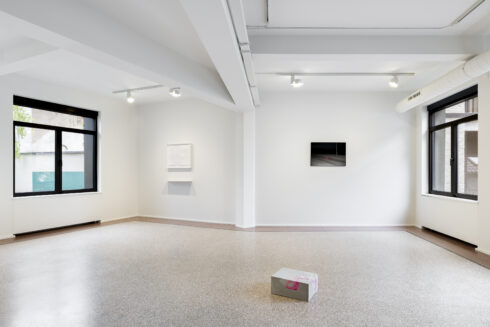
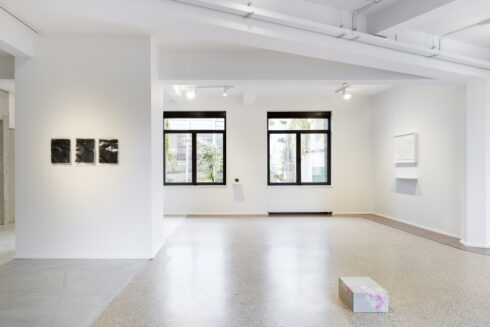
Untitled XXV (Alguna gravity and levity, presence and disappearance. The photograph dwells on the edge of reality, where perception falters. Direccion series)
For Manifesta in St. Petersburg, Francis Alÿs restaged a personal, unfulfilled memory: a failed teenage road trip from Brussels to Moscow with his brother in a Lada 1500. The original journey was cut short when the car broke down. Alÿs delves into the absurdity of nostalgia and the urge to relive the pas...
the northern lights. The gesture stems from an invitation to travel together which was declined, and the journey never took place. Yeung projects the imagined experience onto the stone, allowing care and longing to crystallise in its surface. The object becomes a proxy for intimacy deferred, for affection displaced, for a shared moment that never came to be.
Claire Andrzejczak, in Duration, grasps at suspended seconds in a family photograph Duration Claire Andrzejczak, in when individuals teeter between movement and stillness, between performance and
authenticity. These polaroid images were preserved in a sheet of paper, then tucked away among her everyday belongings. Forgotten, then occasionally rediscovered, the paper was folded and unfolded over time. Marked by use, its creases resemble a landscape, a trace of time and touch.
In Switching Off Stonehenge and in Turning On Stonehenge, Jamie Reid and Martin Sexton revisit a 1913 ceremony in which Stonehenge was symbolically “switched off”. Like the digital advice to “turn it off and on again,” this gesture proposes a reset—not of devices but of collective consciousness and cultural memory.
Second Floor
In Untitled, Elena Bajo collects debris from the L.A. River—discarded fragments destined for oblivion. The plastic, designed to outlast human use, is encased in
concrete, underlining the tension between waste and monument. Bajo elevates the everyday, challenging conventional hierarchies of value and questioning what we choose to preserve or discard.
In a vain attempt to freeze time and decay, Nadia Guerroui’s Untitled places humble flowers in industrial, vacuum-sealed plastic bags. Flimsy and ephemeral in nature, the flowers’s decomposition is slowed to an unnaturally prolonged pace in the absence of air. Evoking a contemporary still life, Guerroui invites reflection on the desire to control time and nature.
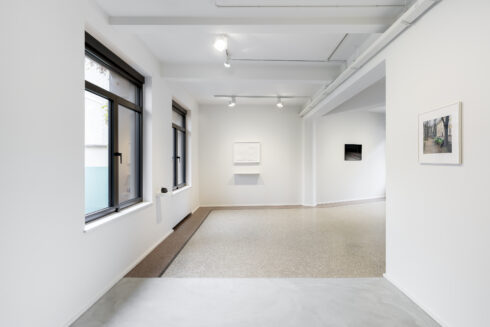
Violeta Mayoral captures an undefined moment—hovering between day and night, gravity and levity, presence and disappearance. The photograph Untitled XXV (Alguna Direccion series) dwells on the edge of reality, where perception falters. For Manifesta in St. Petersburg, Francis Alÿs restaged a personal, unfulfilled memory: a failed teenage road trip from Brussels to Moscow with his brother in a Lada 1500.
The original journey was cut short when the car broke down. Alÿs delves into the absurdity of nostalgia and...
rewind it. The drive, repeated in a 1977 Lada Kopeika, ends with a crash into a tree in the courtyard of the Winter Palace, symbolising the shattering of youthful illusions.
Declined Invitation is a piece of spectrolite known for its shifting, multicoloured shine. Trevor Yeung has partially polished its surface, coaxing out a glimmer reminiscent of the northern lights. The gesture stems from an invitation to travel together which was declined, and the journey never took place. Yeung projects the imagined experience onto the stone, allowing care and longing to crystallise in its surface.
The object becomes a proxy for intimacy deferred, for affection displaced, for a shared moment that never came to be.
Claire Andrzejczak, in Duration, grasps at suspended seconds in a family photograph when individuals teeter between movement and stillness, between performance and authenticity. These polaroid images were preserved in a sheet of paper, then tucked away among her everyday belongings. Forgotten, then occasionally rediscovered, they were folded and unfolded over time. Marked by use, its creases resemble a landscape, a trace of time and touch.
In Switching Off Stonehenge and Turning On Stonehenge, Jamie Reid and Martin Sexton revisit a 1913 ceremony in which Stonehenge was symbolically “switched off”. Like the digital advice to “turn it off and on again,” this gesture proposes a reset—not of devices but of collective consciousness and cultural memory.
Third Floor
Stefano Faoro’s fragile sculpture The actors by their presence always convince me that most of what I’ve written is false invites the viewer into a relationship with the figures depicted—chosen for their positioning, with their backs turned to us. Faoro encourages us to consider what the characters are gazing upon or to imagine seeing the world through their eyes.
In contrast, the statue in Gaëlle Choisne’s Ka looks directly back at the viewer, challenging the audience’s gaze. In this reversal, the historical object, photographed at the National Archeological Museum of Naples, is no longer a passive entity to be observed but becomes an active participant in the interaction.
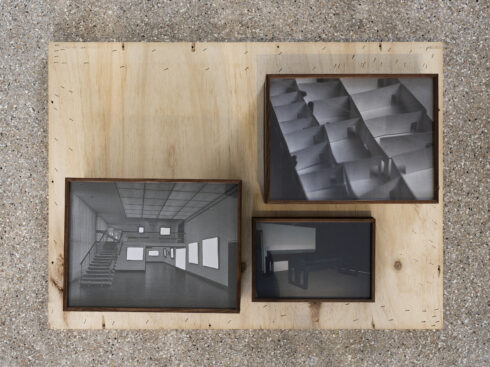
If the museum typically operates as a site of legibility—where objects are categorised, histories ordered, and meaning assigned—Sten Ceulemans’s series of photographs From the cellar to the sun opens up a provisional space. Architectural elements are subtly warped, vitrines emptied, and frames rendered void through analog interventions. A fragmentary counter-archive, these images act as speculative blueprints—accompanied by a Prototype for an Entry Ticket—for an institution imagined otherwise.
Also engaging with the potential and t...
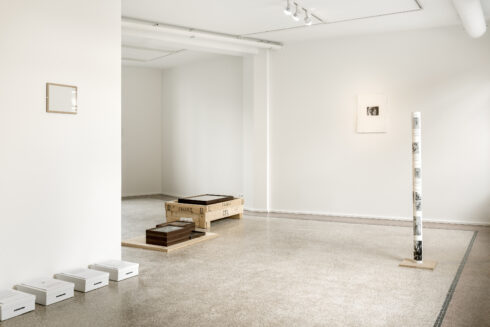
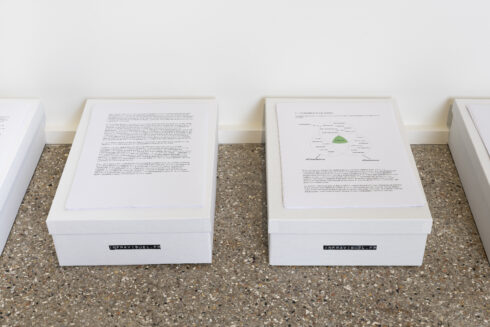
in 2016 and made freely accessible online, the text remains open to revision, inviting additions and reinterpretations over time. It is meant to be picked up and put down, shared, and repurposed. Visitors are encouraged to take a copy home, not as a keepsake but as a tool: to be activated, misused, and folded into other contexts. In doing so, infravisuel embraces impermanence, offering a proposition for how artistic
knowledge might circulate—not as fixed doctrine, but as a living, evolving form.
Stay in the loop.
Events and exhibitions straight to your inbox
By clicking send, you’ll receive occasional emails from Cloud Seven. You always have the choice to unsubscribe